Obtaining hundreds of thousands of processing depth big data from just one
laser processing hole
Laser processing has attracted much attention in recent years as a new manufacturing and
processing technology that can be applied to materials that are difficult to process, such
as carbon fiber composite materials and glass. In order to promote the industrial
application of laser processing as a technology that can be designed and controlled, it is
essential to understand the complex physical and chemical phenomena occurring during laser
processing and to elucidate its principles. Recent research has also revealed that a
combination of machine learning and large-scale first-principles calculations, which have
made remarkable progress in recent years, can be a powerful method for achieving this goal.
This requires the collection of a large amount of data on the depth and shape of the
fabricated hole for various conditions of the laser beam, such as intensity, wavelength, and
pulse width. However, since laser processing is an irreversible phenomenon, the experiments
require the fabrication of many laser holes and their measurements. This limits the number
of experiments that can be conducted and makes it difficult to obtain a large amount of
systematic learning data.
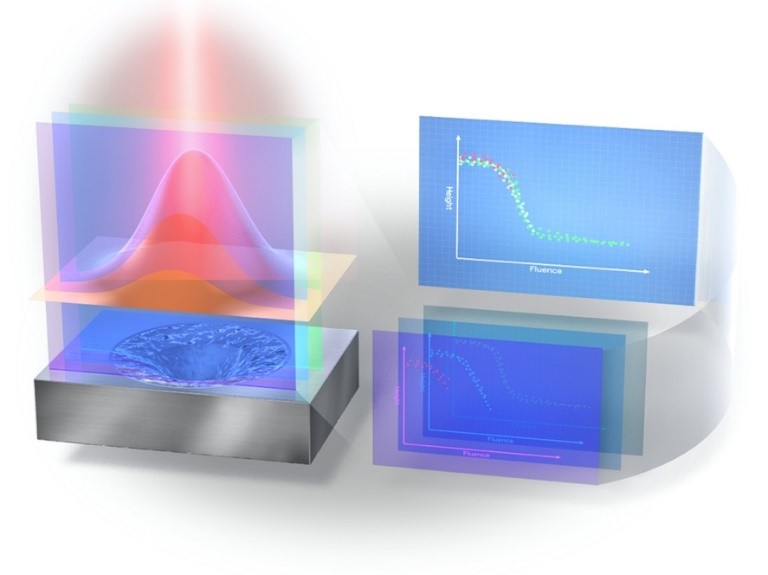
In this research, we have developed a new method (“fluence mapping”) that can obtain
hundreds of thousands of data points from only one laser processing hole at a time by using
imaging technology (Fig. 1). By focusing on the fact that the intensity distribution of
laser pulses is spatially non-uniform, we succeeded in visualizing the relationship between
the intensity of laser light and the processing depth for each location by strictly
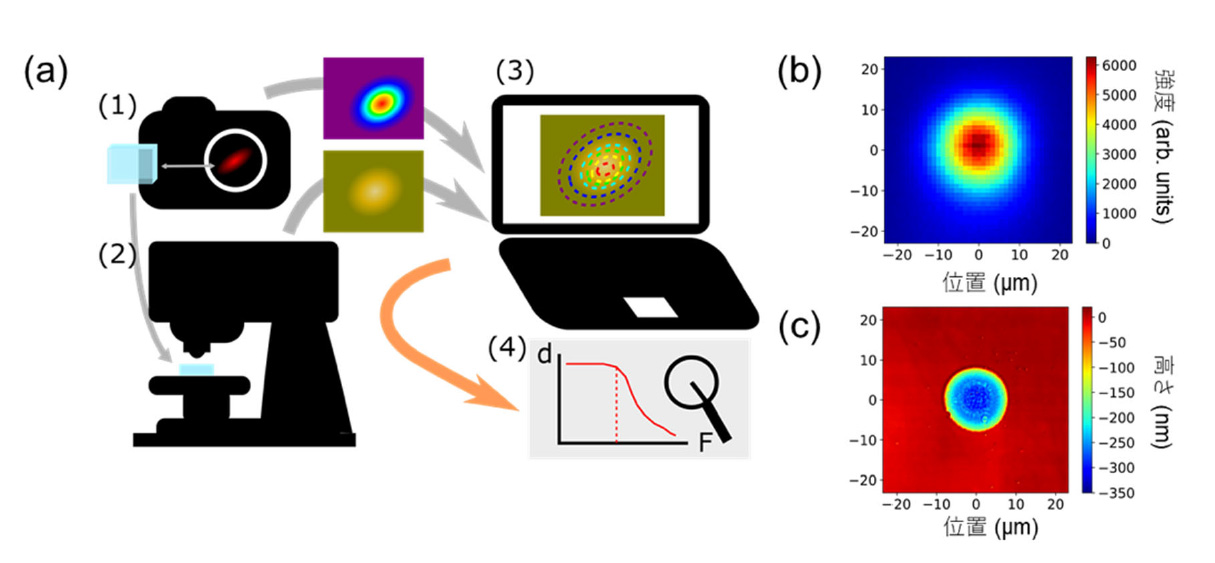
superimposing the intensity distribution of laser light measured with a homemade beam
profiler and the depth distribution of the processed hole measured with a laser microscope
(Fig. 2). We have succeeded in visualizing the relationship between laser beam intensity and
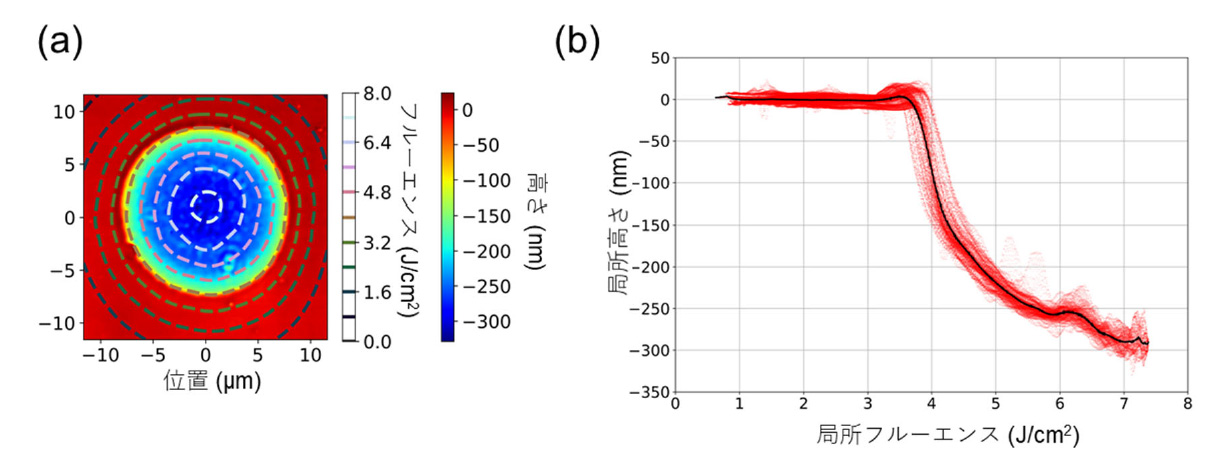
processing depth for each location (Fig. 2). By doing so, we were able to obtain hundreds of
thousands of data points from a single hole at once (Fig. 3), whereas previous methods could
only obtain a limited amount of information such as hole depth and hole radius from a single
hole. This method dramatically improves the efficiency of data acquisition required for
machine learning and enables the systematic acquisition of reliable data for comparison with
first-principles results.
Figure 1:
Conceptual diagram of the invented fluence mapping method
Figure 2:
(a) Overview of the fluence mapping method. The measured local fluence distribution by a
self-made beam profiler (1) and the measured hole depth by a laser microscope (2) are
superimposed by numerical processing (3) and output as a histogram called “fluence map” (4).
(b) Measured beam profile at the focal point of the laser pulse used for processing. (c)
Measured height profile of a sapphire hole machined with a single laser pulse of 1030 nm
wavelength and 190 fs pulse width.
Figure 3:
(a) Superimposed information of the local fluence of the laser beam and the fabricated hole
height profile. (b) Histogram (“fluence map”) showing the relationship between local fluence
and local height.
Published paper:
Haruyuki Sakurai, Kuniaki Konishi, Hiroharu Tamaru, Junji Yumoto, Makoto Kuwata-Gonokami
" Direct correlation of local fluence to single-pulse ultrashort laser ablated morphology ",
Communications Materials, 2: 38 (2021).